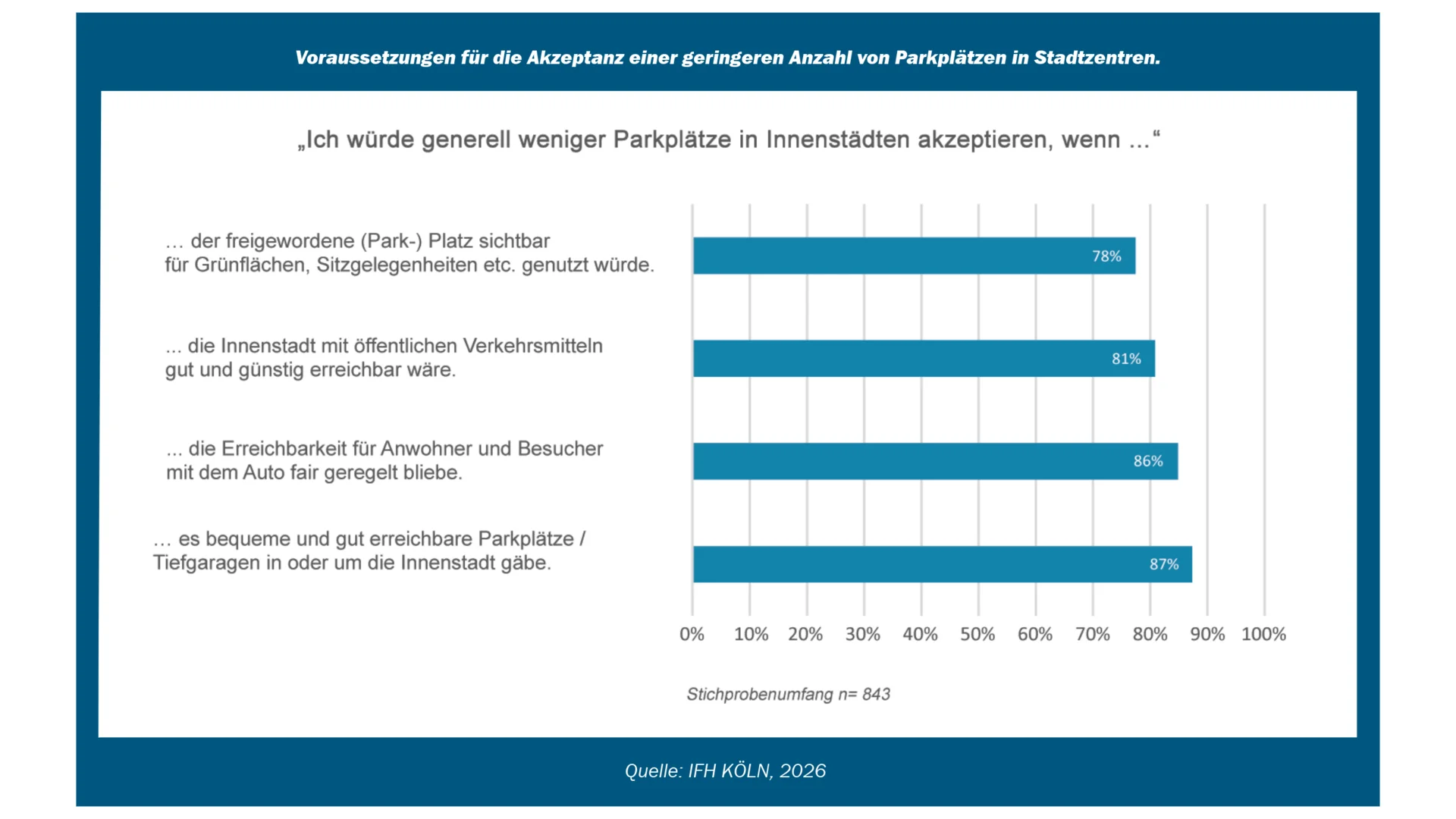
Paderborn / Cologne, 15 September 2026. Fewer on street parking spaces are widely accepted even among drivers, provided that city centres remain easily accessible and suitable parking facilities are available. This is the finding of a nationwide survey conducted by IFH KÖLN on behalf of Lödige Industries to mark European Mobility Week. 87 percent of respondents who drive into city centres at least occasionally would accept fewer parking spaces in city centres if convenient and easily accessible multi storey or underground car parks were available.
The results show that car use and a willingness to reorganise parking space do not have to be contradictory. For 46 percent of the 1,056 respondents, the car is the most frequently used mode of transport for visits to city centres. At the same time, 93 percent consider good accessibility a fundamental requirement when visiting a city centre.
Broad support across all age groups
The willingness to accept fewer parking spaces in city centres if convenient and easily accessible multi storey or underground car parks are available in or around the city centre is similarly high across all age groups surveyed. Approval ranges from 85 percent among respondents aged 60 to 75 to 89 percent among those aged 40 to 49. There is also virtually no difference between rural and urban regions, with approval at around 87 percent in both.
The findings address a central question of European Mobility Week, which takes place from 16 to 22 September 2026. Under this year's theme, "Mobility for Everyone Across Generations", the campaign focuses on how mobility and street spaces can meet the needs of different age groups. This includes safe road crossings, sufficient space, places to stop and spend time, and good accessibility.
Fewer parking spaces in favour of greenery and safety
According to the survey, acceptance of reallocating street space also depends on how the newly available space is used. 78 percent of respondents who drive into city centres occasionally or regularly would accept fewer parking spaces if the space gained were visibly used for green areas, seating or other amenities. 73 percent would support a reduction if it made streets safer for pedestrians and cyclists.
"The results show that accessibility and quality of public space should not be treated as opposing objectives. A clear majority is open to fewer parking spaces on the street if suitable alternatives are available and the space gained delivers a visible benefit. For urban development and real estate planning, it is therefore important to consider parking requirements at an early stage and organise parking spaces as compactly as possible. This allows accessibility to be maintained while reducing the amount of space required for parking," says Dr Tobias Wennekamp, Chief Product Officer at Lödige Industries.
Mobility concepts must reflect local conditions
While the general acceptance of reorganising parking space is almost equally high in urban and rural areas, the importance of parking availability for visits to city centres differs. In rural regions, 86 percent consider good parking facilities a fundamental requirement for visiting a city centre. In urban regions, the figure is 68 percent.
The potential impact of better organised parking also varies. 84 percent of respondents from rural regions would visit city centres more frequently if parking were easier or better organised. In urban regions, the figure is 68 percent. These findings underline the need for mobility concepts to take local transport infrastructure and the different options available for travelling into city centres into account.
Consolidating parking to reclaim public space
Overall, 73 percent of all respondents agree that parking spaces, parking bays and roadside parking areas in city centres should be replaced by compact multi storey or underground car parks. A similar proportion, 74 percent, consider good parking facilities a fundamental requirement for visiting a city centre.
The findings therefore highlight a potential approach to planning urban spaces. By consolidating parking and organising it efficiently in terms of space, accessibility can be maintained while freeing up areas of public street space for other uses. For municipalities, urban planners and project developers, the organisation of stationary traffic therefore becomes an integral part of urban and mobility planning.
About IFH KÖLN
As an industry expert, IFH KÖLN provides information, market research and consulting services on retail related topics, helping organisations successfully shape the future and develop suitable business models. IFH KÖLN is a leading source of independent, well founded data, analyses and strategies designed to make companies and retail locations successful and future proof.
By analysing markets, customers and competition, IFH KÖLN provides a 360° perspective for developing strategies around retail related topics. In customised projects, customers are supported with strategic questions relating to digital strategies, the development of new markets and target groups, and channel excellence. Through its subsidiary brand ECC KÖLN, IFH KÖLN has been active in e commerce since 1999 and focuses on community building and knowledge transfer relating to the digitalisation of retail.
About Lödige Industries
Lödige Industries supports architects, project developers and municipal planners from the early stages of projects in developing space efficient parking concepts. The company designs and delivers car lifts as well as semi automated and fully automated parking systems for new builds and existing properties.
Headquartered in East Westphalia, Germany, the company is a global market leader in air cargo terminals and automated parking systems and is also one of the leading suppliers of logistics systems for warehousing and industry as well as lift solutions. With subsidiaries around the world, Lödige Industries supplies material handling solutions to a broad range of customers.
Founded in 1948, the family owned medium sized company specialises in delivering complex material flow systems, covering planning, engineering, manufacturing, programming and commissioning as well as service. In 2025, Lödige Industries generated revenue of EUR 246 million. The company employs around 1,500 people.
About automated parking systems
Depending on the project and system, automated parking systems can reduce the amount of space required for parking by up to 60 percent compared with conventional solutions. They make it possible to accommodate parking spaces even where ramps, driving lanes or limited site dimensions make conventional solutions difficult to implement.